The Next Evolution of Digital Twins, Cognitive Automation, and Cyber-Physical Systems
The global industrial landscape is undergoing a profound structural transformation. Over the past decade, organizations across sectors—ranging from renewable energy and manufacturing to urban planning and ecological conservation—have leaned heavily into digitization. The initial phase of this transition relied on traditional Digital Twins: static or semi-reactive virtual models that mirrored physical assets based on historical or batch-processed data. While revolutionary at their inception, these traditional models are rapidly approaching their operational limits in an increasingly volatile, data-saturated world.
Today, we are witnessing the birth of the next paradigm shift: Intelligent Virtual Replicas (IVRs).
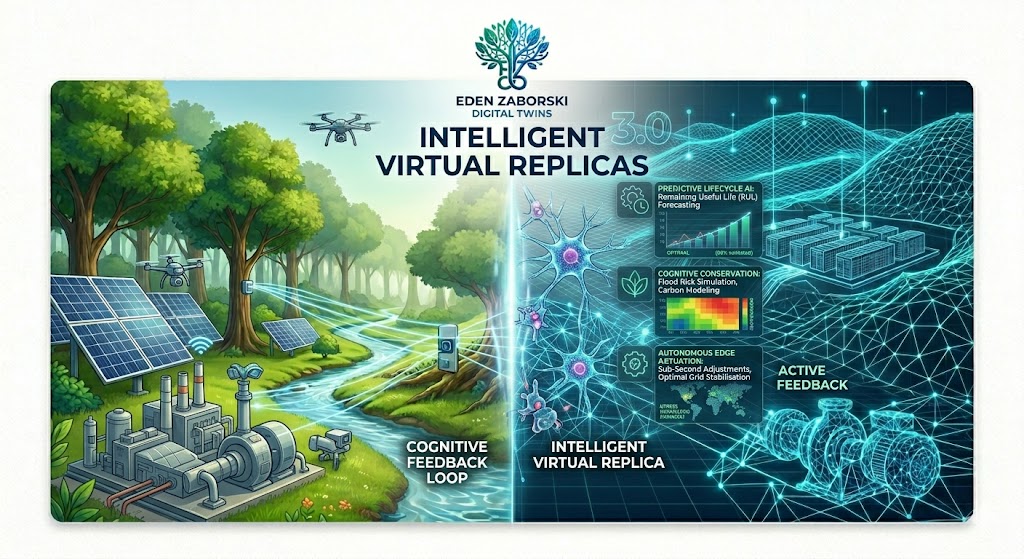
An Intelligent Virtual Replica is not merely a digital mirror; it is a cognitive, self-learning, and autonomously evolving digital ecosystem. By fusing high-fidelity spatial modeling with advanced artificial intelligence, machine learning ($ML$), continuous edge computing, and real-time cyber-physical feedback loops, IVRs possess the ability to perceive, reason, predict, and act. This comprehensive paper explores the architecture, cognitive capabilities, cross-industry applications, and strategic advantages of Intelligent Virtual Replicas, outlining why they represent the definitive future of asset management and operational resilience.
1. Deconstructing the Paradigm: Digital Twins vs. Intelligent Virtual Replicas
To appreciate the strategic value of Intelligent Virtual Replicas, one must first differentiate them from first-generation digital twins. The evolution can be categorized across three distinct dimensions: autonomy, cognitive depth, and bidirectional synchronization.
The Static Twin (Generation 1)
First-generation twins were essentially advanced Computer-Aided Design (CAD) models or Geographic Information System (GIS) layers augmented with basic historical data. They answered the question: “What did the asset look like, and how did it perform last month?” They lacked real-time awareness and required manual data updates.
The Connected Twin (Generation 2)
Second-generation twins introduced Internet of Things (IoT) connectivity, pulling real-time telemetry from physical sensors into a visual dashboard. They answered the question: “What is the asset doing right now?” While useful for live monitoring, these systems still relied entirely on human operators to interpret anomalies, run manual diagnostics, and determine corrective actions.
The Intelligent Virtual Replica (Generation 3 / Present)
An Intelligent Virtual Replica represents the cognitive tier of cyber-physical systems. Driven by continuous neural network evaluation and physics-informed AI, an IVR answers the ultimate operational questions: “What will the asset do tomorrow, why will it do it, and what autonomous adjustments must be made right now to optimize its lifecycle?”
| Architectural Dimension | Connected Digital Twin (Gen 2) | Intelligent Virtual Replica (Gen 3) |
| Data Ingestion | Continuous but fragmented IoT streams. | Harmonized multi-modal streams (Sensors, Vision, Contextual). |
| Cognitive Ability | Rule-based alerts and basic thresholding. | Machine learning, predictive inference, and cognitive reasoning. |
| Feedback Loop | Unidirectional (Physical $\rightarrow$ Digital visualization). | Bidirectional (Physical $\leftrightarrow$ Digital autonomous control). |
| Evolvability | Static architecture; requires manual reprogramming. | Self-learning; continuously recalibrates based on real-world drift. |
2. The Cognitive Architecture of an IVR
The transition from a standard connected twin to an Intelligent Virtual Replica requires a highly sophisticated, layered software and hardware architecture. This cognitive stack ensures that data is not just visualized, but intellectually processed and operationalized.
[ Multi-Modal Sensor Ingest ] ──> [ Cognitive Processing Layer ] ──> [ Edge Execution & Feedback ]
            │                                     │                                  │
     (IoT, Computer Vision,                (Physics-Informed AI,              (Autonomous Adjustments,
      Environmental Context)                Predictive Engines)                Smart Infrastructure)
Layer I: Multi-Modal Contextual Ingestion
Traditional twins look at isolated data points, like temperature or pressure. An IVR practices multi-modal ingestion. It blends structured IoT sensor data with unstructured data sources—including live computer vision feeds from drones, acoustic monitoring, local meteorological forecasts, historical maintenance logs, and macroeconomic energy pricing. This creates a dense, multi-dimensional understanding of the asset’s current reality.
Layer II: The Cognitive Processing Core (Physics-Informed AI)
Pure data-driven machine learning models can sometimes hallucinate or propose solutions that defy physical reality. IVRs solve this by utilizing Physics-Informed Neural Networks (PINNs). The AI operating within the replica is trained not just on pure data, but on the immutable laws of physics, thermodynamics, and fluid dynamics governing the physical asset.
For instance, if an IVR is monitoring a hydroelectric dam, its predictive algorithms operate strictly within the bounds of hydraulic pressure equations and material stress constraints. This ensures that its predictive simulations are flawlessly accurate and structurally safe.
Layer III: The Autonomous Edge Execution Loop
The true differentiator of an IVR is the closed, bidirectional feedback loop. When the cognitive core identifies an optimization path or an impending vulnerability, it doesn’t merely ping a human dashboard. If authorized within defined operational boundaries, the IVR communicates directly with edge actuators on the physical asset, executing sub-second adjustments to valves, rotational speeds, electrical distributions, or thermal controls to neutralize risks and maximize efficiency instantly.
3. High-Impact Applications Across Global Industries
Intelligent Virtual Replicas are sector-agnostic, providing transformative capabilities wherever physical machinery, complex infrastructure, or delicate ecosystems interact with digital oversight.
I. Ecological Systems and Managed Natural Assets
In an era defined by climate change and aggressive conservation mandates, natural environments must be protected with the same technological sophistication as heavy industrial plants.
- Cognitive Forestry and Carbon Replicas: By combining satellite radar data, IoT soil moisture meshes, and localized weather AI, an IVR can construct a living model of a managed forest reserve. The replica autonomously simulates how a projected heatwave will impact localized wildfire risks and carbon capture metrics, directing automated irrigation systems or drone-based observation teams to vulnerable micro-zones before degradation occurs.
- Dynamic Marine Ecosystem Protection: IVRs can model entire coral reefs or coastal industrial zones, continuously tracking water salinity, temperature anomalies, and industrial runoff. The system can predict toxic algae blooms weeks in advance, alerting local authorities to temporarily alter upstream water treatment or shipping lanes to safeguard marine biodiversity.
II. Advanced Renewable Energy Infrastructure
The erratic nature of renewable energy generation (wind, solar, hydro) requires a management platform that can adapt at the speed of changing weather patterns.
- Self-Optimizing Wind Ecosystems: Wind turbines operating in a field do not work in isolation; the wake generated by a forward turbine inherently degrades the wind quality for the turbines behind it. An Intelligent Virtual Replica models the entire kinetic airflow of the wind farm in real time. It dynamically adjusts the blade pitch and yaw of individual forward turbines to optimize the collective airflow, increasing total farm energy yield by up to $5-8\%$ while significantly reducing mechanical fatigue.
- Predictive Solar Grid Balance: By pairing sky-imaging computer vision networks with power grid telemetry, a solar facility IVR can predict exact cloud-cover durations down to the second. It calculates the temporary drop in megawatt generation and autonomously balances the load with localized battery storage systems, ensuring perfect grid stabilization without human intervention.
III. Smart Cities, Civil Architecture, and Infrastructure
Modern urban spaces are massive, hyper-complex webs of interdependent utilities, transit lines, and structural elements.
- Living Structural Diagnostics: Bridges, tunnels, and high-rise buildings equipped with fiber-optic strain sensors and acoustic monitoring feed data into an urban IVR. The replica continuously monitors structural integrity against traffic loads and seismic vibrations. If a microscopic structural fracture begins to propagate deep within concrete decking, the IVR isolates the anomaly, runs a simulation to determine weight capacity changes, and triggers an automated maintenance order while adjusting urban traffic light timings to reduce load stress on the structure.
4. The Business Case: Measurable Value and Operational ROI
Transitioning from a passive data strategy to an active Intelligent Virtual Replica is a significant capital investment, but one that delivers exponential returns across the entire lifecycle of an enterprise.
1. Radical Reduction in Total Cost of Ownership (TCO)
By replacing scheduled maintenance with absolute predictive necessity, IVRs eliminate the astronomical expenses of premature equipment overhauls and unnecessary spare-parts hoarding. Maintenance becomes an exact science: components are serviced or swapped precisely before failure, maximizing their full Remaining Useful Life (RUL) and driving down operational expenditures ($OpEx$) dramatically.
2. Elimination of High-Consequence Downtime
In asset-heavy industries, unplanned downtime can cost millions of dollars per hour. Because an IVR is constantly running thousands of hyper-accelerated “what-if” simulations in the background, it identifies systemic degradation long before it registers on traditional warning panels. Catching an error early turns a potentially catastrophic multi-day emergency shutdown into a brief, controlled, and scheduled maintenance window.
3. Institutional Knowledge Preservation
When veteran engineers and operations managers retire, they often take decades of nuanced asset intuition with them. An Intelligent Virtual Replica inherently codifies this human intuition. By observing human decisions, historical logs, and mechanical outcomes over time, the machine learning engines internalize how to optimally run the facility, preserving operational excellence permanently within the organizational software layer.
5. Navigating the Implementation Journey
Deploying an Intelligent Virtual Replica requires a strategic, phased approach to ensure seamless integration with legacy systems and immediate time-to-value.
Phase 1: High-Fidelity Digitization & Sensor Mapping
The baseline requires building an accurate geometric and physical model of the target asset or environment. Legacy CAD models are converted into interactive, spatial 3D environments, while a dense array of modern IoT devices, edge cameras, and telemetry networks are installed to act as the sensory nervous system of the physical asset.
Phase 2: Data Harmonization and Semantic Webbing
Raw telemetry from thousands of disparate manufacturers and sensor APIs is funneled into a centralized data pipeline. Here, the data is harmonized into a standardized syntax, establishing a clean, unified, and sub-second latency data pool that the processing engines can read without bottlenecking.
Phase 3: Activating Cognitive Automation
With the data loop established, the Physics-Informed AI models are turned on. The system begins a “learning phase,” monitoring historical actions and refining its predictive baseline. Once accuracy thresholds hit $100\%$ validation, the bidirectional loop can be activated—gradually granting the IVR the autonomy to execute low-risk operational changes directly at the edge, while escalating complex, high-consequence decisions to human administrators via immersive, single-pane dashboards.
Conclusion: The Unavoidable Digital Imperative
The luxury of relying on reactive or slow-moving asset management strategies has expired. In a world defined by compounding environmental shifts, aggressive efficiency requirements, and intense economic competition, organizations must operate with total clarity and predictive assurance.
Intelligent Virtual Replicas provide that assurance. By transforming passive data into real-time, cognitive, and actionable foresight, they empower modern enterprises to future-proof their physical investments, optimize their operations to absolute peak performance, and protect vital ecological capital. The gap between organizations running blind and those operating with the intellectual clarity of an IVR will define the industrial leadership of the coming decades.
The future is no longer a guessing game—it is an optimized, living virtual reality. Let us build the intelligent duplicate of your world today.