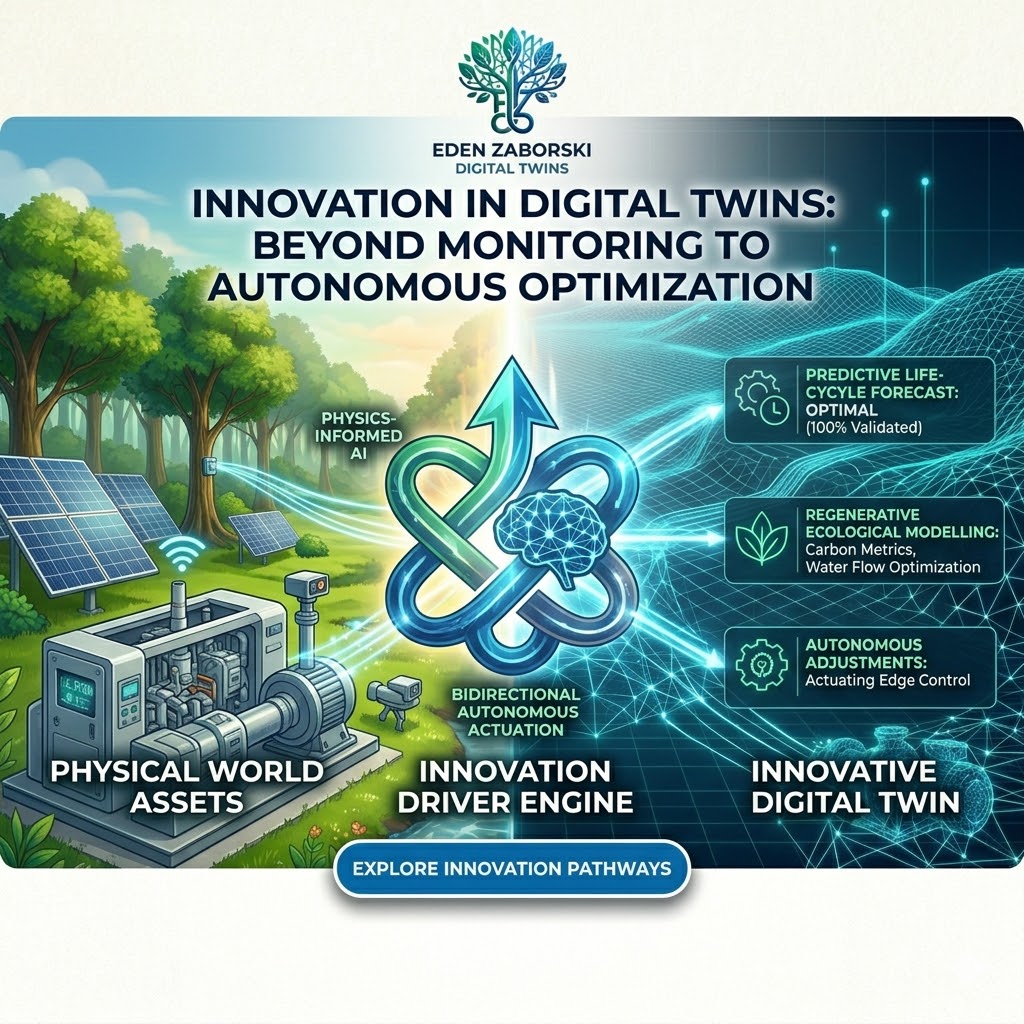
Pioneering the Cyber-Physical Frontiers of Autonomous Optimization and Sustainable Engineering
The trajectory of industrial digitization has reached a critical inflection point. For past decades, organizations relied heavily on static observation and historical data pipelines to govern their physical investments. When the first iterations of Digital Twins emerged, they fundamentally altered this paradigm by offering a virtual mirror of physical assets. Yet, as the complexities of global infrastructure scale, climate pressures intensify, and the volume of enterprise data reaches exponential proportions, the standard, reactive digital twin is no longer sufficient.
We are currently entering an era defined by profound Innovation in Digital Twins.
This innovation is not marked by incremental upgrades in computing speed or prettier 3D renderings. Instead, it is characterized by a foundational convergence of bleeding-edge technologies: Physics-Informed Neural Networks ($PINNs$), Decentralized Data Ledgers (Blockchain), Edge Computing, Next-Generation Spatial Computing, and Autonomous Bidirectional Actuation. Collectively, these advancements are shifting digital twins from passive operational dashboards into hyper-intelligent, self-evolving, and entirely autonomous engine rooms of innovation. This comprehensive paper explores the core technological breakthroughs driving this revolution and their structural impacts on industry, society, and ecological preservation.
1. The Drivers of Breakthrough Innovation
To grasp the depth of modern innovation within this space, we must analyze the structural limitations of legacy systems that necessitated these technological leaps.
Historically, digital twins suffered from data latency, high computational overhead, and a stark vulnerability known as “model drift”—where the digital representation progressively fails to match the degrading reality of the physical asset over time. Modern innovations have systematically eliminated these bottlenecks through three fundamental pillars:
I. Fusing Artificial Intelligence with Pure Physics
Early digital twins relied on pure data-driven machine learning ($ML$) models. While excellent at pattern recognition, these models lacked an inherent understanding of physical boundaries, occasionally suggesting mathematically sound but structurally impossible interventions.
The integration of Physics-Informed Neural Networks (PINNs) stands as a monumental innovation. By embedding the fundamental laws of nature—such as the Navier-Stokes equations for fluid dynamics, the laws of thermodynamics, and Hooke’s law for structural elasticity—directly into the AI’s loss functions, the twin guarantees that its predictions are always tethered to reality. The AI doesn’t just guess what will happen based on data; it simulates what must happen according to the laws of physics.
II. Sub-Second Latency and Edge Compute Paradigms
In mission-critical scenarios—such as managing an automated electrical grid or stabilizing an offshore wind turbine during a gale—sending terabytes of raw sensor data to a centralized cloud server introduces unacceptable latency.
Innovation in edge-computing architectures allows the digital twin’s cognitive models to run directly on localized hardware near the physical asset. Data is processed, anomalies are detected, and optimization simulations are executed in sub-second cycles, ensuring immediate operational responsiveness.
III. Bidirectional Autonomous Actuation
The defining characteristic of next-generation digital twin innovation is the closing of the loop. Historically, a twin was a unidirectional system: physical sensors fed data to a digital screen, and a human operator manually decided what action to take.
Today’s innovative twins possess bidirectional capability. Operating within predefined safety guardrails, the digital twin evaluates an upcoming risk, tests millions of corrective simulations in seconds, chooses the optimal course of action, and communicates directly back to the physical equipment’s edge actuators to modify configurations—all without human latency.
[ Physical World Assets ] ──( Real-Time Telemetry )──> [ Intelligent Edge Twin Core ]
           ▲                                                        │
           │                                             (Runs Physics-Informed AI)
           │                                                        │
           └───( Autonomous Actuation / Feedback )──────────────────┘
2. Structural Arenas of Transformation
The ripples of these technological innovations are reshaping diverse sectors, transforming how humanity interacts with built environments, renewable energy grids, and fragile natural ecosystems.
I. Next-Generation Renewable Energy Ecosystems
As the global energy mix trends decisively toward decentralized, renewable sources, managing the inherent volatility of wind, solar, and hydro energy demands unmatched operational agility.
- Aerodynamic Wake Harvesting in Wind Farms: In a traditional wind array, forward-facing turbines generate massive downwind turbulence (wakes), drastically reducing the efficiency of the turbines behind them. Innovative digital twins model the invisible, complex fluid dynamics of the entire wind field in real time. By autonomously adjusting the yaw and blade pitch of the lead turbines, the twin steers the wind wake around the trailing units. This increases collective farm efficiency by up to $7\%$ while actively curbing mechanical stress and micro-fractures.
- Predictive Cloud-Grid Synchronicity: Solar arrays utilize localized sky-imaging cameras powered by computer vision to track incoming cloud coverage. The digital twin ingests these visual streams, projects exact shade durations to the second, simulates the resulting drop in megawatt output, and preemptively routes localized battery reserves onto the grid to maintain absolute stabilization.
II. Cognitive Cities and Civil Infrastructure
Modern cities are moving away from siloed utility management toward highly integrated, hyper-connected urban replicas.
- Subterranean Hydro-Resilience: Underground water and sewage networks are inherently difficult to monitor physically. Innovative twins leverage acoustic sensor arrays and machine learning to map subterranean stress. If a minute vibration signature flags a micro-fracture deep beneath a primary thoroughfare, the twin runs a localized simulation to calculate the structural erosion rate against current traffic loads. It then autonomously reroutes automated municipal water valves to depressurize the line and triggers a targeted, preventative maintenance request before a catastrophic sinkhole can form.
- Dynamic Structural Lifecycles: Major bridges, dams, and sky-rises are now cast with internal fiber-optic sensor nets. The digital twin reads structural load changes, temperature expansions, and seismic vibrations. Over decades of service, the twin continuously recalculates the asset’s Remaining Useful Life (RUL), allowing municipalities to execute need-based restorations rather than relying on arbitrary, budget-draining scheduled overhauls.
III. Ecological Regeneration and Natural Capital
Perhaps the most profound arena of innovation is the application of digital twin frameworks to protect the biosphere and optimize environmental stewardship.
- Living Forestry and Carbon Accounting: By synthesizing high-resolution LiDAR scans, satellite multispectral imaging, and subterranean IoT meshes, conservationists construct living virtual duplicates of dense forest reserves. The digital twin accurately tracks carbon sequestration levels tree by tree, evaluates localized wildfire vulnerabilities based on changing soil moisture indexes, and allows land managers to simulate the long-term ecological impact of projected climate shifts with total mathematical precision.
3. The Economic Realities of Innovation
Deploying highly innovative digital twin architectures requires a forward-thinking shift in capital allocation, yet the returns generated across an asset’s lifecycle are profoundly transformative.
| Operational Dimension | The Legacy System Framework | The Innovative Digital Twin Model |
| Maintenance Ideology | Reactive or rigidly scheduled calendar intervals. | Fully predictive; executed exactly at the point of necessity. |
| Data Architecture | Disconnected data pools and organizational silos. | Harmonized single source of truth with sub-second sync. |
| Asset Longevity | Truncated by undetected stress and micro-wear. | Safely maximized through continuous, real-time tuning. |
| Ecological Footprint | High material waste; opaque compliance data. | Near-zero resource waste; automated, auditable ESG metrics. |
Maximizing Resource Efficiency and TCO
When an organization transitions to a physics-informed predictive twin model, the Total Cost of Ownership ($TCO$) of heavy infrastructure plummets. By understanding the precise degradation curves of individual components, parts are never replaced prematurely—slashing industrial waste—nor are they allowed to fail catastrophically. The economic dividends of shifting unplanned downtime into minor, highly coordinated maintenance windows routinely measure in millions of dollars in saved operational revenue.
4. The Path Forward: Designing the Architecture of Tomorrow
For organizations looking to harness the full potential of digital twin innovation, the road map requires an deliberate, step-by-step technological integration:
- Establish the Nervous System (The Ingest Layer): Deploy high-fidelity IoT sensors, acoustic monitors, and vision arrays capable of capturing the true physical and mechanical state of the asset.
- Harmonize the Data Streams (The Integration Layer): Break down systemic operational silos. Unify fragmented data pools into a single, standardized, low-latency processing pipeline that feeds the digital core.
- Activate Cognitive Autonomy (The Intelligence Layer): Implement physics-informed neural network models to begin continuous optimization loops. Grant edge actuators the autonomy to execute real-time, low-risk operational balances while streaming clear, immersive, 3D situational intelligence to human command centers.
Conclusion: The Cyber-Physical Imperative
Innovation in digital twin technology has evolved past the point of being a luxury or a speculative corporate experiment. In an age characterized by intense economic competition, accelerating environmental volatility, and complex industrial scaling, running an enterprise without real-time predictive foresight is a profound operational risk.
By turning passive data streams into a cognitive, living, and autonomous reality, modern digital twin innovations empower organizations to completely future-proof their physical assets, safeguard natural ecosystems, and push operational efficiency to its absolute theoretical peak. The industrial winners of the coming decades will be defined entirely by their ability to bridge the physical and digital domains with intellectual clarity and fearless innovation.
The digital twin of your future is ready to evolve. Let us build it together.