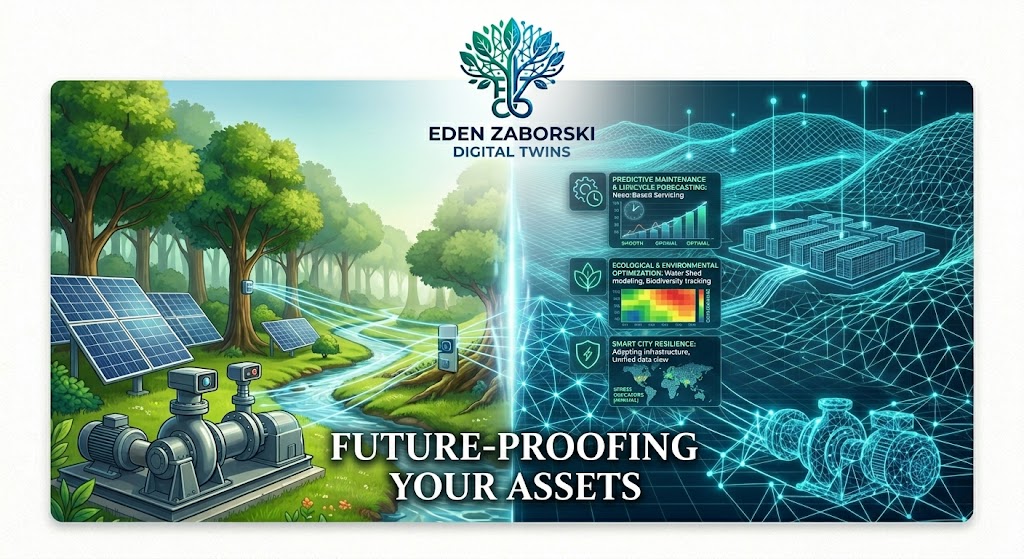
The Strategic Imperative of Digital Twin Technology in an Age of Disruption
The landscapes of modern industry, infrastructure, and environmental management are shifting at a pace never before witnessed in human history. Organizations across the globe face an intricate, interconnected web of challenges: accelerating climate volatility, stringent regulatory frameworks prioritizing sustainability, rapidly aging physical assets, and the relentless pressure to optimize operational efficiency. In this volatile environment, traditional asset management paradigms—built upon reactive maintenance, fragmented data silos, and historical guesswork—are no longer merely inefficient; they are a liability.
To survive and thrive in this new era, enterprises must transition from defensive risk mitigation to proactive, intelligent resilience. They must future-proof their assets.
At the vanguard of this industrial evolution is the concept of the Digital Twin—a dynamic, living, high-fidelity digital replica of a physical asset, process, or entire ecosystem. Far from being a static 3D model or a simple visualization tool, a digital twin acts as a continuous bridge between the physical and digital worlds, absorbing real-time operational data and outputting actionable foresight. By implementing a sophisticated digital twin strategy, organizations can transform their physical assets from vulnerable economic liabilities into highly resilient, continuously optimized engines of growth.
1. Defining the Threat Landscape: Why Physical Assets Are Vulnerable
To understand the necessity of future-proofing, one must first examine the compounding vulnerabilities currently facing physical infrastructure, renewable energy systems, and managed ecological environments.
The Failure of Reactive and Scheduled Maintenance
For decades, asset management operated on two primary models: reactive maintenance (fixing components after they break) and preventative scheduled maintenance (servicing components at rigid, arbitrary time intervals). Both approaches possess severe systemic flaws. Reactive maintenance introduces unpredictable downtime, sky-high emergency repair costs, and potential cascading system failures. Conversely, scheduled maintenance often leads to over-servicing—unnecessarily replacing perfectly functional components, driving up operational expenditures, and generating excess industrial waste.
Climate Volatility and Environmental Stress
Physical infrastructure is increasingly subjected to unprecedented environmental extremes. Renewable energy assets, such as wind turbines and solar arrays, must endure volatile weather patterns, micro-climatic shifts, and structural stresses that accelerate wear-and-tear. Similarly, managed natural ecosystems and agricultural terrains face rapid shifts in soil chemistry, moisture levels, and biodiversity loss. Without a mechanism to simulate and monitor these stresses in real time, asset operators remain perpetually blind to the hidden vulnerabilities developing within their assets.
The Explosion of Disconnected Data
Modern industrial sites are flooded with data from thousands of IoT sensors, telemetry units, SCADA systems, and drone surveys. However, the vast majority of this data remains trapped in isolated organizational silos. When engineering, maintenance, and executive leadership teams cannot access a single, unified view of asset health, decision-making slows, errors compound, and critical early-warning signs are missed.
2. The Anatomy of a Future-Proof Asset: The Digital Twin Architecture
Future-proofing is not about making an asset indestructible; it is about making an asset intelligent, adaptable, and predictable. Digital twin technology accomplishes this by creating a continuous, closed-loop relationship between physical reality and digital simulation. This sophisticated architecture is built upon three core operational pillars:
[ Continuous Physical Telemetry ] ──( Sub-Second Sync )──> [ Machine Learning Analytics ] ──> [ Immersive 3D Visualization ]
                                                                       │
                                                                       └───> [ Proactive Operational Action ]
Pillar I: Continuous Physical Telemetry (The Ingest Layer)
The foundation of a digital twin relies on high-fidelity data acquisition. By deploying advanced IoT sensors, thermal cameras, vibration monitors, and autonomous drone networks across a physical asset, we capture its live, operational pulse. This layer handles everything from mechanical vibrations in an industrial pump to soil moisture fluctuations across a delicate watershed.
Pillar II: Machine Learning and Predictive Analytics (The Intelligence Engine)
Once raw data is ingested, it is fed into an advanced analytics engine. Here, machine learning algorithms compare live operational metrics against historical performance benchmarks and physics-based models. The engine establishes a highly accurate baseline of “optimal health” and continuously runs simulated “what-if” scenarios, calculating structural risks and forecasting the Remaining Useful Life (RUL) of individual components.
Pillar III: Immersive 3D Spatial Visualization (The Interface Layer)
Data is only valuable if human operators can rapidly interpret and act upon it. The digital twin translates complex algorithmic outputs into an intuitive, interactive 3D spatial mapping environment. Operators no longer review dense spreadsheets or obscure error codes; instead, they step into a living, visual rendering of their infrastructure, superimposed with real-time heatmaps, stress indicators, and environmental metrics.
3. Strategic Solutions: Future-Proofing Across Sectors
Digital twin technology is highly versatile, delivering specific, transformative solutions tailored to the unique demands of distinct economic and environmental sectors.
I. Renewable Energy Infrastructure: Maximizing ROI and Lifespan
As the global transition to clean energy accelerates, the operational efficiency of renewable energy assets is paramount. Wind turbines, solar fields, and hydroelectric facilities are often located in remote, harsh environments where physical inspections are costly and hazardous.
- Predictive Wind Dynamic Modeling: By pairing live wind speed and torque data with a digital twin, operators can predict exactly when bearing wear will lead to mechanical failure. This allows maintenance teams to schedule repairs during periods of low wind generation, minimizing energy revenue losses.
- Solar Array Optimization: Digital twins track micro-fluctuations in solar panel efficiency alongside local weather data, instantly identifying defective inverter strings or unexpected dust shading, ensuring the facility consistently operates at maximum capacity.
II. Ecological and Environmental Optimization: Protecting Natural Assets
Future-proofing is not restricted to heavy steel and concrete; it is equally vital for the preservation of natural capital. Conservationists, land managers, and eco-conscious enterprises leverage digital twins to safeguard delicate ecosystems against climate change and industrial encroachment.
- Watershed and River Basin Replicas: By modeling river topography, rainfall patterns, and real-time sensor streams, a digital twin can accurately forecast flood risks, monitor chemical runoff, and simulate the long-term impact of drought on local agriculture.
- Carbon Capture and Biodiversity Tracking: Digital twins allow land managers to superimpose historical biodiversity indexes and vegetation health metrics over a live geographic interface. This enables highly precise tracking of carbon sequestration levels and ensures conservation funds are deployed exactly where ecosystems are most vulnerable.
III. Smart Cities and Infrastructure: Urban Resilience
For modern municipalities and commercial real estate developers, building urban resilience means designing structures that adapt to the populations using them.
- Utility Grid Harmonization: A digital twin aggregates real-time data from water lines, electrical grids, and traffic patterns into a single-pane-of-glass dashboard. If a subterranean water pipe experiences a sudden pressure drop, the system flags the precise location of the leak before it causes localized flooding or structural erosion to nearby roadways.
- Thermal Efficiency & Carbon Footprint Reduction: By simulating airflow, human occupancy, and solar heat gain within a 3D digital duplicate of a high-rise building, property managers can dynamically adjust HVAC systems, slashing energy consumption and maintaining compliance with carbon reduction mandates.
4. The Financial and Operational ROI of Digital Twins
Investing in digital twin technology is a profound strategic advantage that yields immediate and long-term economic dividends.
| Strategic Metric | The Reactive Approach | The Digital Twin Approach |
| Maintenance Expenditures | High emergency repair fees; frequent over-servicing. | Optimized, need-based servicing; low overhead costs. |
| Asset Lifecycle | Truncated due to undetected structural stress. | Maximized safely via continuous health monitoring. |
| Operational Downtime | Unplanned, catastrophic, and prolonged. | Planned, minimized, and strategically scheduled. |
| Resource & Material Waste | High electronic/industrial waste from premature swaps. | Near-zero waste; components swapped at the perfect time. |
Elimination of Catastrophic Downtime
When a critical industrial asset fails unexpectedly, the cost is not limited to the price of a replacement part; it encompasses halted production lines, idle labor, and damaged client trust. By utilizing sub-second latency syncing and real-time anomaly detection, a digital twin catches structural deviations in their infancy. Identifying a micro-fracture or a minor thermal spike weeks before it leads to a total system blowout transforms a catastrophic failure into a routine, low-cost maintenance task.
Accelerated Sustainability and Compliance
In the modern corporate regulatory environment, transparency is mandatory. Regulatory bodies increasingly require verifiable data regarding carbon emissions, environmental impacts, and material waste. A digital twin inherently acts as an immutable, real-time audit log of an asset’s ecological footpint. Organizations can confidently demonstrate compliance, avoid heavy environmental penalties, and attract premium ESG (Environmental, Social, and Governance) investments.
5. Implementing a Future-Proof Roadmap
Transitioning to a digital twin-driven asset management model requires a deliberate, step-by-step implementation strategy. Future-proofing is an iterative journey that consistently delivers value at every stage.
Phase 1: Audit and Connect
The journey begins with an exhaustive audit of your existing physical architecture. Identify the critical operational variables that dictate the success or failure of your asset. Next, deploy targeted hardware—such as industrial IoT sensors, specialized cameras, or telemetry gateways—to establish an uninterrupted data pipeline from the physical world to the cloud.
Phase 2: Unify and Harmonize
Break down the data silos within your organization. Ingest fragmented data streams into a centralized, unified digital twin processing platform. During this phase, data is scrubbed, standardized, and cross-referenced, establishing a singular, dependable source of truth for engineering, operations, and executive decision-makers alike.
Phase 3: Visualize and Simulate
Deploy the 3D visualization layer to grant your team complete situational awareness. Once the live, visual baseline of your asset is running seamlessly, activate the predictive analytics engines. Train machine learning algorithms on your unique operational parameters to unlock advanced simulations, automated lifecycle forecasting, and early-stage anomaly warnings.
6. Embracing the Twin Revolution
The future cannot be predicted using the static tools of the past. As climate disruptions intensify and industrial complexities grow, the gap between organizations that possess real-time digital foresight and those operating blindly will widen into an insurmountable chasm.
Future-proofing your assets is an active commitment to operational excellence, environmental stewardship, and long-term economic survival. By turning your data into a living reality through digital twin technology, you eliminate the risks of guesswork, protect vital physical ecosystems, and ensure your enterprise remains unshakeable—no matter what the future holds.
The digital counterpart of your world is waiting to be built. Let us build it together.