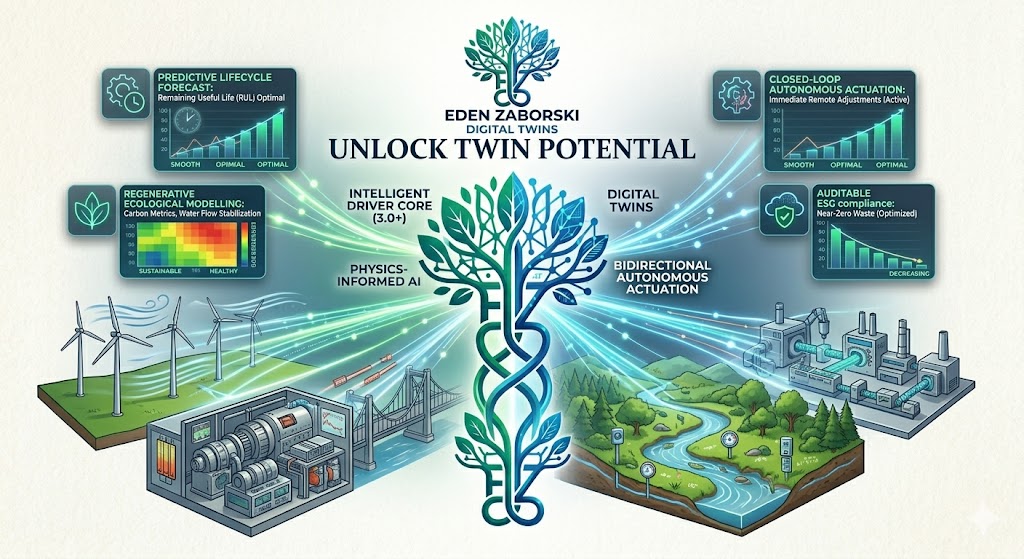
Maximizing ROI, Operational Excellence, and Environmental Capital Through Strategic Scale
The modern industrial, infrastructural, and ecological sectors are confronting a convergence of severe operational pressures. Global supply chains remain highly sensitive to disruptions, regulatory compliance mandates for decarbonization are tightening globally, and physical assets are being subjected to unprecedented stress from climate volatility. To survive in this high-stakes environment, enterprises can no longer rely on conventional, siloed data frameworks or retrofitted asset management policies.
Many organizations have already taken the foundational step of deploying Digital Twins—virtual mirrors that ingest real-time data from their physical counterparts. Yet, a critical industry-wide challenge has emerged: a vast majority of enterprises are utilizing their digital twins merely as advanced visualization dashboards or glorified alarm systems. They are monitoring reality, but they are not transforming it.
To truly outpace disruption, organizations must move beyond passive tracking. They must Unlock Twin Potential.
Unlocking twin potential means shifting from an asset-isolated, monitoring-centric framework to an enterprise-wide, cognitive, and autonomously optimizing network. It is the process of extracting maximum strategic value, exponential return on investment ($ROI$), and deep ecological resilience from your digital architecture. This paper outlines the strategic roadmap, mathematical imperatives, and systemic innovations required to transition your digital twins from basic operational data streams into supreme drivers of institutional value.
1. The Bottleneck: Why Most Twins Underperform
Before an organization can unlock the full performance capabilities of its digital twin framework, it must diagnose the invisible barriers that keep legacy configurations constrained.
[ Isolated Sensor Data ] ──( Siloed Infrastructure )──> [ Basic Dashboard ] ──> [ Reactive Human Fixes ]
                                                                                   (Bottlenecked Value)
The Trap of Isolated Deployment
The most common mistake in digital twin implementation is the “silo trap.” A company might deploy a highly sophisticated twin for a specific piece of machinery—such as an industrial pump or a singular solar inverter—without connecting that model to the broader operational workflow. When a twin operates in isolation, its insights are bottlenecked. It cannot calculate how a micro-failure in one sector ripples across the entire supply chain, utility grid, or surrounding natural ecosystem.
Data Rich, Insight Poor
Modern industrial facilities generate terabytes of telemetry every hour via IoT sensor meshes, thermal arrays, and drone inspections. However, raw data is not inherently valuable. When an enterprise lacks advanced machine learning models capable of contextualizing this data against physics-based baselines, human operators become overwhelmed by a phenomenon known as “alert fatigue.” Critical warning signs become lost in a sea of non-urgent notifications, and the twin is reduced to a reactive troubleshooting utility rather than a predictive powerhouse.
The Human Latency Bottleneck
Even when a connected digital twin successfully flags a future structural vulnerability or efficiency loss, the path to remediation is often slowed down by corporate bureaucracy and human latency. If an insight must travel through multiple layers of manual review, engineering audits, and scheduling approvals before a physical adjustment is made, the window of maximum financial and operational opportunity closes.
2. The Pillars of Unlocked Potential
To shatter these limitations and truly unlock your twin’s latent potential, your digital twin strategy must evolve across three critical dimensions: systemic integration, cognitive foresight, and automated execution loops.
Pillar I: Holistic Systemic Orchestration (Macro-Twins)
An asset does not exist in a vacuum, and neither should its twin. Unlocking full potential requires connecting individual asset models into a comprehensive ecosystem of twins, often called a Macro-Twin.
For example, in a smart city or industrial port infrastructure, the digital twins governing transit networks, water distribution lines, and electrical grids are woven into a singular, interconnected software fabric. If a transit delay occurs, the macro-twin automatically calculates the altered human density patterns inside nearby buildings and commands the HVAC systems to shift their thermal output preemptively, maximizing energy efficiency across the entire municipality.
Pillar II: Physics-Informed Machine Learning ($PIML$)
Purely statistical data models are highly susceptible to “model drift”—where structural changes or unique environmental variations cause the AI to output flawed predictions. Unlocking a twin’s true analytical potential requires anchoring its machine learning models to the immutable laws of nature.
By integrating physics equations—such as fluid dynamics, thermal transfer coefficients, and mechanical stress metrics—directly into the neural network architecture, the twin understands why an asset behaves the way it does. The twin can run ultra-accelerated, highly accurate simulations of extreme events (e.g., severe weather grids, unexpected power surges) with $100\%$ structural fidelity, providing executives with reliable foresight that pure data tracking cannot match.
Pillar III: Bidirectional Closed-Loop Actuation
The ultimate stage of unlocking digital twin potential is the transition from a passive advisory system to an active, closed-loop operational partner.
When a twin discovers a pathway to optimize efficiency or mitigate a developing risk, it shouldn’t just send a text alert. Operating safely within strict, predefined regulatory and engineering guardrails, the digital twin communicates back across the digital-to-physical divide, sending commands directly to localized edge controllers to realign hardware, balance pressures, or alter energy paths dynamically.
3. High-Value Realizations Across Sectors
When an enterprise successfully unlocks its digital twin framework, the operational results are immediate, visible, and profoundly transformative.
I. Renewable Energy Networks: Autonomous Yield Optimization
In the clean energy sector, margins are tightly coupled with unpredictable environmental forces. Unlocked digital twins transform how wind, solar, and hydro assets interact with their natural surroundings.
- Dynamic Wind Farm Coordinate Adjustments: In a wind array, lead turbines create massive, chaotic air turbulence behind them, which robs downwind turbines of clean airflow and accelerates blade wear. An unlocked twin continuously models the invisible aerodynamic fluid fields of the entire facility. It dynamically adjusts the yaw and angle of the lead turbines to guide the wake around the trailing assets, increasing overall wind farm energy production by up to $6-9\%$ while significantly extending the lifecycle of the trailing gearboxes.
- Intelligent Solar Grid Balancing: By integrating sky-facing computer vision cameras with electrical load telemetry, a solar facility’s twin projects incoming cloud movements down to the exact second. The system calculates the imminent drop in generation capacity and seamlessly coordinates with localized commercial battery storage systems to release power before a ripple of instability hits the broader public grid.
II. Ecological Stewardship and Natural Assets
Unlocking twin potential is equally essential for the defense and optimization of natural capital and environmental reserves.
- Cognitive Watershed Replacements: Land managers and environmental conservationists construct comprehensive twins of river basins and protected watersheds. By combining real-time IoT water quality sensors with remote-sensing satellite imagery and advanced meteorological AI, the unlocked twin accurately simulates flood boundaries and chemical runoff variations weeks before severe storm systems hit. This enables agricultural operations to pause fertilizer applications precisely when runoff risks are high, saving money and safeguarding local river biodiversity.
III. Heavy Manufacturing and Critical Civil Infrastructure
For massive infrastructure investments, structural failure is simply not an option. Unlocked twins turn structural health into an exact, predictable science.
- Predictive Structural Lifecycle Forecasting: Modern bridges, high-rises, and industrial facilities are embedded with fiber-optic strain gauges. The unlocked twin ingests these continuous stress streams and models decades of cumulative fatigue in real time. Instead of relying on expensive, arbitrary calendar-based shutdowns for inspections, maintenance teams execute hyper-targeted fixes exactly at the point of structural necessity, safely maximizing the asset’s useful life and driving down Total Cost of Ownership ($TCO$).
4. The Economic Framework: Operational and Strategic ROI
The decision to scale a digital twin framework from basic monitoring to fully unlocked potential represents a calculated, highly lucrative business strategy.
| Strategic Parameter | The Basic Monitoring Model | The Unlocked Twin Architecture |
| Maintenance Protocol | Reactive or rigidly scheduled calendar intervals. | Fully predictive; executed exactly at the point of necessity. |
| Data Synchronization | Fragmented data pipelines; high human latency. | Harmonized single source of truth with sub-second sync. |
| Asset Lifespan | Vulnerable to unmonitored environmental wear. | Maximized safely via continuous micro-adjustments. |
| Resource Efficiency | High operational overhead and material waste. | Near-zero resource waste; automated ESG tracking. |
The Eradication of Downtime
When an unlocked digital twin operates with continuous, low-latency data syncing and advanced anomaly detection models, it identifies mechanical or structural degradation long before traditional physical safety triggers are tripped. Catching a microscopic component flaw or thermal spike weeks in advance allows operations managers to convert an expensive, multi-day emergency system failure into a minor, pre-planned, and highly efficient maintenance window.
Automated ESG and Regulatory Compliance
In today’s corporate climate, transparent environmental auditing is a mandatory operational requirement rather than an elective public relations strategy. An unlocked digital twin inherently functions as an immutable, continuous record of an asset’s carbon intensity, resource utilization, and waste profiles. This data allows companies to seamlessly generate verified sustainability compliance reports, shielding the organization from punitive ecological penalties and positioning them to capture premium green-capital investments.
5. The Implementation Blueprint: A Phased Strategy to Scale
Unlocking the true potential of your digital twin network is an iterative process that systematically delivers clear financial and operational value at every benchmark of the deployment:
- Phase 1: Synthesize and Harmonize (The Architecture Foundation): Audit your existing data streams. Break down internal departmental silos and pull disparate sensor data, historical logs, and visual feeds into a single, centralized low-latency processing pipeline.
- Phase 2: Introduce Cognitive Intelligence (The Modeling Layer): Augment the standard 3D visual models with physics-informed neural network engines. Train your AI on the specific physical constraints and operational baseline behaviors of your infrastructure to unlock highly accurate predictive simulations.
- Phase 3: Empower Autonomous Action (The Closed-Loop Layer): Gradually transition the twin from a pure recommendation interface to an active controller. Establish strict operational bounds, and authorize the digital twin to execute automated, real-time edge corrections to constantly balance, protect, and optimize your real-world operations.
Conclusion: Embrace Your Predictive Future
The era of managing high-value assets and sensitive ecosystems through historical guesswork and retroactive fixes has ended. In a business and environmental landscape defined by shifting climate pressures, aggressive efficiency metrics, and uncompromising economic competition, running an enterprise without real-time predictive foresight is an existential risk.
By moving past basic visualization and fully unlocking the cognitive, integrated, and bidirectional potential of digital twins, modern enterprises gain total mastery over their operational destiny. Unlocked twins allow you to eliminate unexpected downtime, maximize the safe lifecycles of your physical assets, and run your organization at the peak of sustainable efficiency.
The latent capability of your digital universe is waiting to be capitalized upon. Step into total operational clarity, and unlock your digital twin potential today.